Medical Monday – Deaf & Blind Dogs
Deaf and/or blind dog resources
Deaf and/or blind dogs can live amazing and fulfilled lives. The most important thing to remember is that they are a dog (and their breed) before their disability. So they have all of the same needs as dogs, but fine tuning a few things in both your lives can help you communicate clearly.
Resources:
- Positive Animal Wellness
- Offers online training courses
- Down to Earth Dog Lady–follow on social media.
- She has so many very instructional/informative videos
- She offers virtual sessions (Dr. Gooden has used her!)
- Great podcast: https://soundcloud.com/sarah-stremming/training-blind-and-deaf-dogs-with-erin-marion-cpdt-ka-kpa-ctp
- Deb Bauer with Your Inner Dog
- Has an online training called Uniquely Paws-able
- Has a book on training
- Can also find on social media
- Deaf Dogs Rock
- Training tips including starting to use hand signals on their website
- Keller’s Cause
- Training tips on their website
- emBARK – locally
- Gooden has taken both her deaf and blind Aussie mix and her deaf border collie to many classes at emBARK
- Staff is knowledgeable and very helpful
- Heather (the owner) even sat in on the virtual session for Dr. Gooden’s dog with Down to Earth Dog Lady
Dr. Gooden’s own dogs:
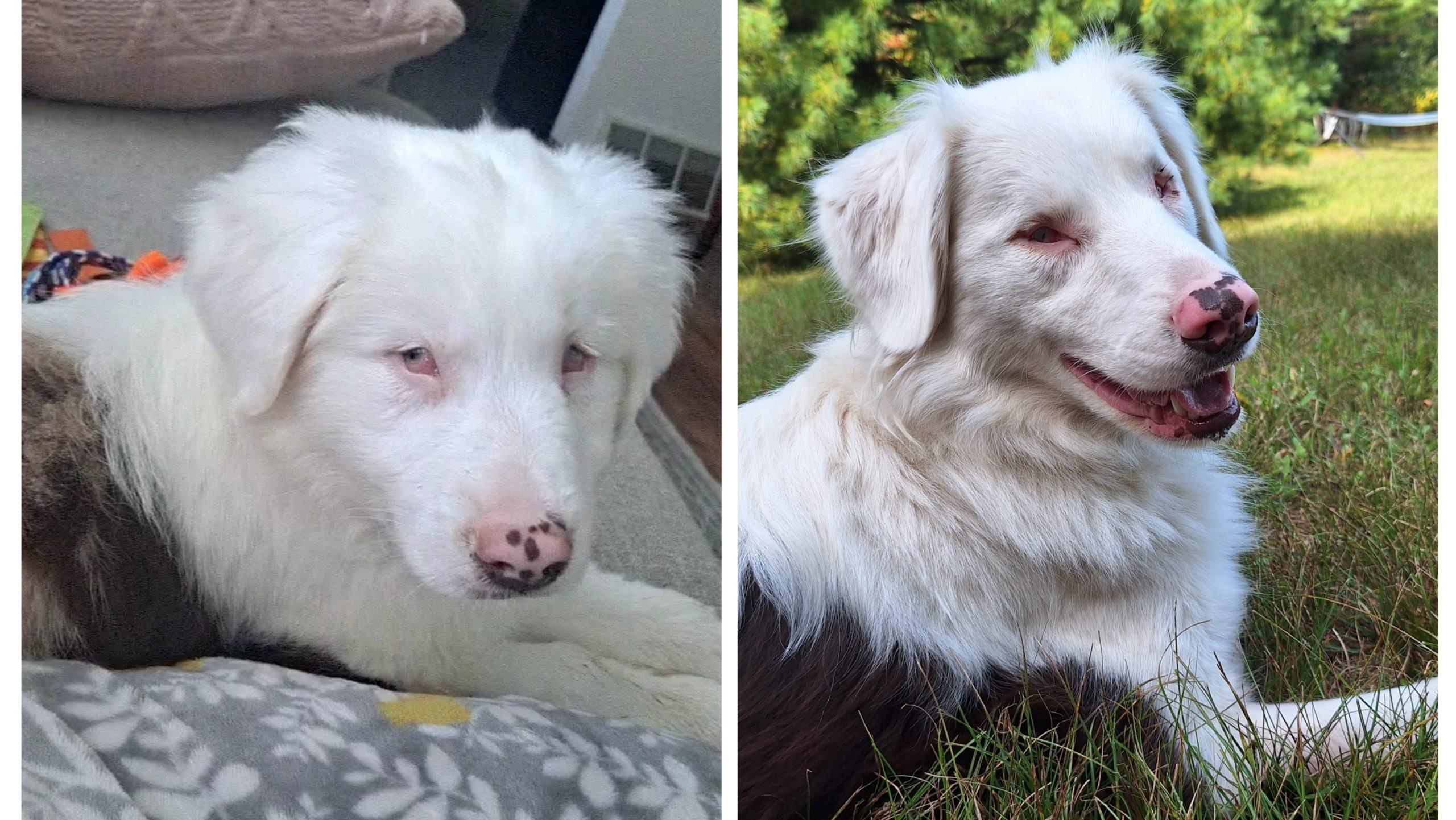
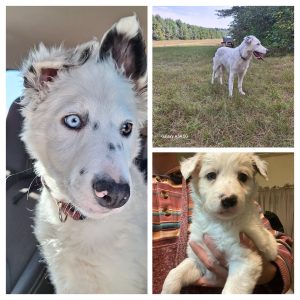
I adopted a deaf/blind Australian Shepherd mix from ECCHA in 2022. He is the result of a breeding between 2 merle dogs. This breeding has a 25% chance of producing a double merle. Most double merle dogs have some form of hearing and or vision limitations. My dog, Oko, is completely deaf and almost completely blind. A consult with an ophthalmologist suggested he was completely blind, however, he does respond to light sometimes. I primarily use touch cues to communicate with Oko. Deaf/blind dogs can be more sensitive to touch so there were some cues that I started with that ultimately changed due to him not being comfortable with them. Due to this sensitivity, it was extra important to me to work on cooperative care and we were able to take a class at emBARK specifically for that. As a puppy, we worked tirelessly on auto check-ins. Because of this, if we are out and about he naturally returns to me about the same time I am becoming uncomfortable with how far away he is. Just like any dog he has some quirks and can be dog selective, but for the most part he LOVES nearly everyone. He plays daily with his 5 dog housemates and loves to snuggle the cats. He attended multiple classes at emBARK including: Puppy Einstein, Real Life Rover, Focus Pocus, Cooperative Care, and a muzzle workshop.
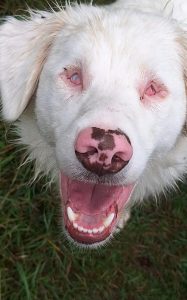
Nashville is a deaf Border Collie from a breeder in Tennessee. He is not the result of a double merle breeding. The breeder did a fantastic job of appropriate genetic testing and even testing the non-merle mother dog for the merle gene to ensure there would not be an accidental double merle breeding. However, genetics are funny and out came Nashville mostly white and deaf. As soon as I saw him, I fell in love and made the drive a few weeks later to pick him up. I communicate with him primarily through hand signals and occasionally touch cues. We also worked on his auto check-in. So when he is about the distance away that I start to get uncomfortable he makes a visual check-in with me. I then wave my arms and do his recall cue. He comes running fast. He can be a bit more challenging than Oko at times. This is because of that dog breed before disability. Border Collies are bred to see and react to movement. This is how the keep sheep together. Since Nash cannot hear, he easily gets distracted by movements in the environment. However, because he is in-tune with movement, it also allows me to get into his periphery and wave my arms to turn his attention to me. He has also attended many classes at emBARK.
Share this resource
[addtoany]
Contact Us
Whether you’re looking to adopt, volunteer or simply want to chat about your love for animals, we’re all ears (and paws). Contact us today!